In this article
 In this article
Get Growth Insights That Convert
Summarize this Article with AI
Open ChatGPT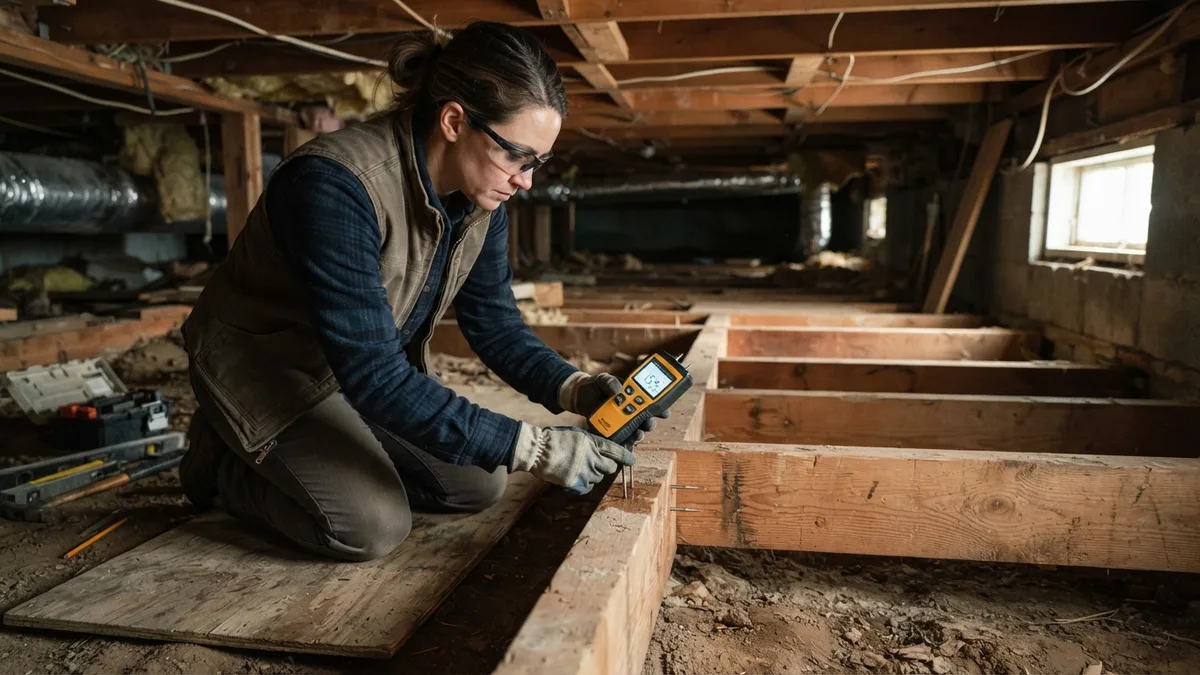
Key Highlights
 Key Highlights
- Oven-drying is the lab standard, but takes hours; pin-type and resistance meters offer quick field results with material-dependent accuracy.
- The wet-basis formula is MC(%) = [(wet weight − dry weight) / wet weight] × 100; dry-basis divides by dry weight instead.
- Always calibrate your meter, take multiple readings at different sample depths, and account for temperature before recording results.
- Common errors include surface-only measurements, ignoring equilibrium moisture content, and skipping calibration—all lead to false high or low readings.
- Karl Fischer titration delivers lab-grade precision for liquids and oils; NIR sensors provide non-destructive analysis for production environments.
Accurate moisture measurement is critical across industries. Too much moisture in stored grain can trigger mold growth and crop loss. Too little in building materials can cause structural failure and warping. Inadequate moisture readings in food manufacturing lead to shelf-life problems and regulatory violations. How to measure moisture content accurately depends on your material, budget, and required precision. This guide covers five established methods, the step-by-step procedure for using a moisture meter, the mathematical formulas behind moisture calculations, and practical tips to ensure reliable readings every time.
What Is Moisture Content
Moisture content is the mass percentage of liquid in the total mass of moist material. It is always expressed as a percentage and can be reported on a wet basis or a dry basis.
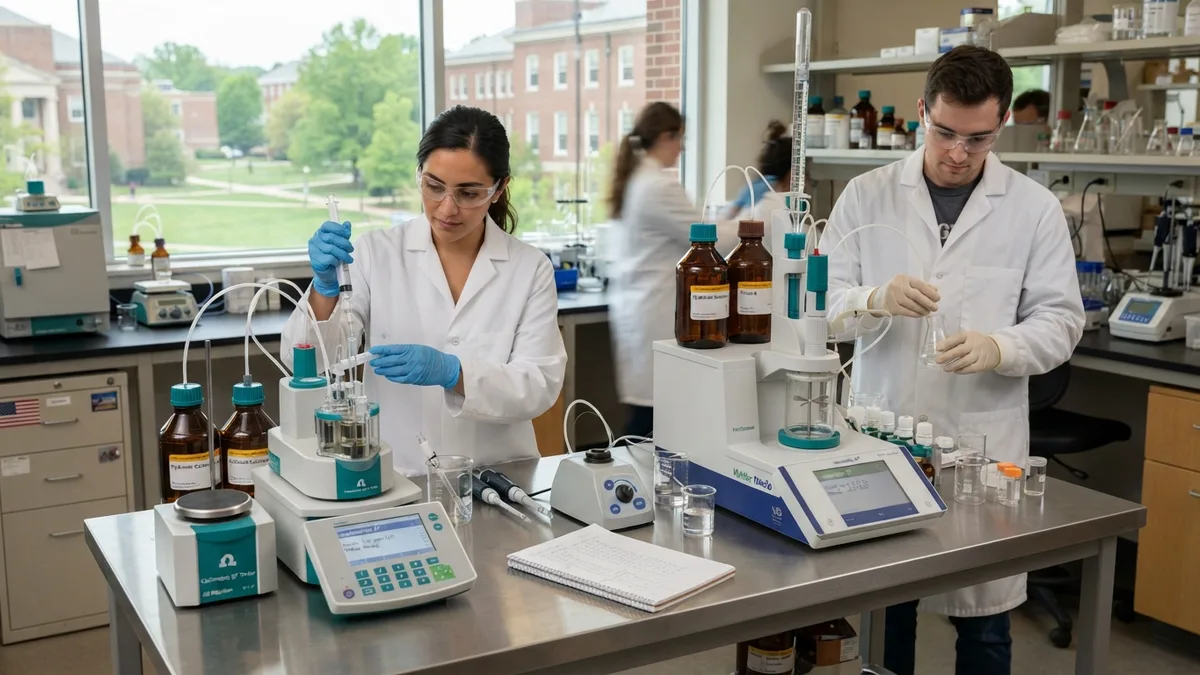
On a wet basis, moisture content is calculated as (wet weight − dry weight) divided by wet weight, then multiplied by 100. This is the most common reporting method in food manufacturing, agriculture, and construction because the wet weight is what you measure in the field.
On a dry basis, the same difference is divided by dry weight instead of wet weight. Dry-basis reporting is preferred in chemistry and timber industries because it directly links moisture to the dry matter in a sample.
For example, a piece of wood might be 15% moisture on a wet basis (15 grams of water per 100 grams of wet wood) or 17.6% on a dry basis (15 grams of water per 85 grams of dry wood). Both describe the same sample; the choice depends on your industry standard and what comparison makes sense for your process.
Why Accurate Moisture Measurement Matters
Inaccurate moisture readings trigger costly failures across every industry. In grain storage, even a 1% error in moisture content can mean the difference between safe long-term preservation and rapid mold invasion. Grain stored at 13% moisture remains stable for months; stored at 15% without cooling, it can heat and spoil within weeks.
In construction and timber, miscalculating moisture content leads to warping, cupping, and structural movement. Wood framing installed at 20% moisture when it should be at 12% will shrink and crack as it dries in place, opening gaps in joints and compromising the building envelope. This damage often becomes visible only years later.
Food manufacturers face shelf-life collapse if moisture is too high, and brittleness or texture loss if too low. A single batch of crackers or cereal that is 2% too moist will absorb flavor from packaging materials and develop off-notes. Moisture that is 2% too low makes the product hard and unpalatable.
Regulatories also depend on accurate measurement. Many food safety standards, timber grading systems, and pharmaceutical formulations have strict moisture windows. Auditors and inspectors verify compliance by testing samples. A meter that reads high when samples are actually within spec can trigger false recalls or rejected shipments.
Laboratories and quality control teams cannot afford guesswork. Accurate moisture content is the foundation of reproducible testing, product consistency, and customer trust.
Methods for Measuring Moisture Content
Five primary methods exist for measuring moisture content. Each trades off speed, accuracy, cost, and destructiveness. The right choice depends on your material, production speed, and regulatory requirements.
Oven-Drying Method (Gravimetric)
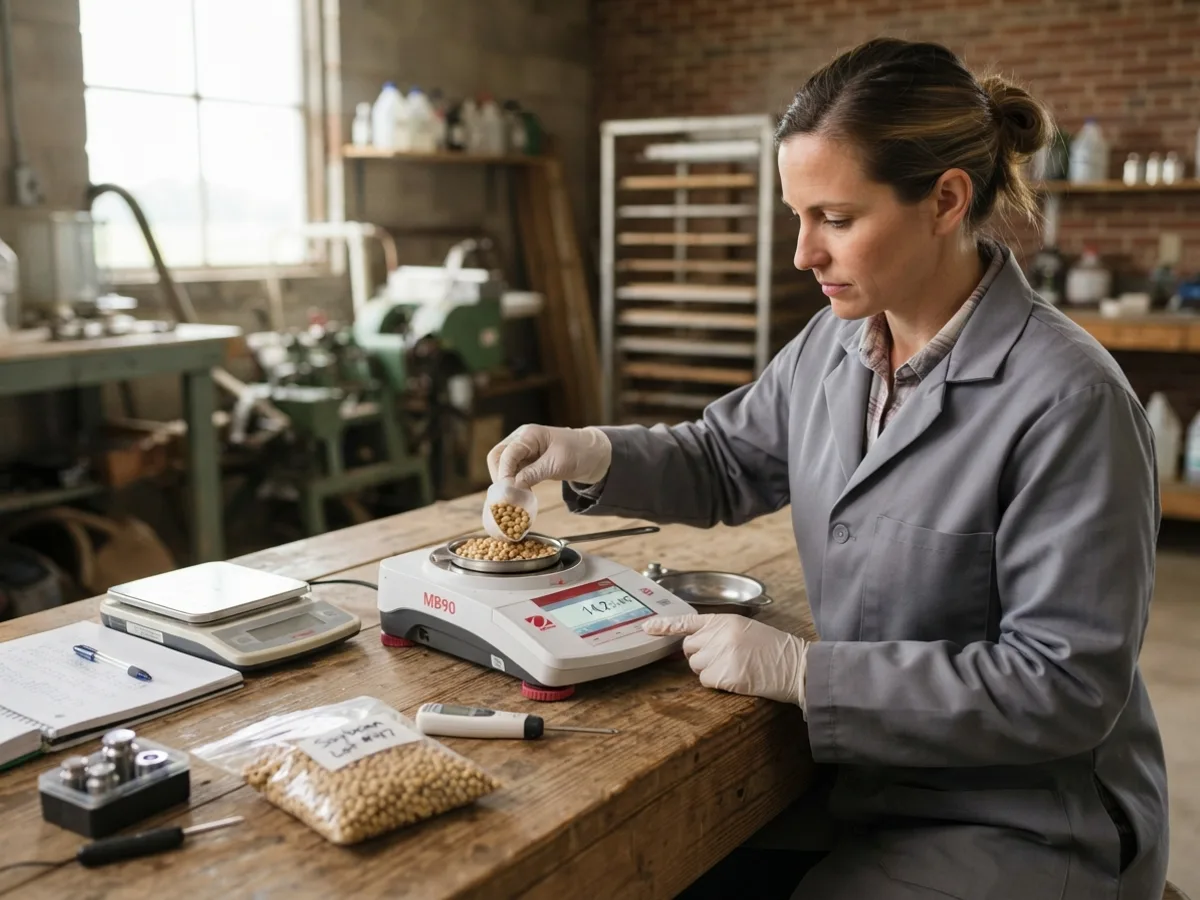
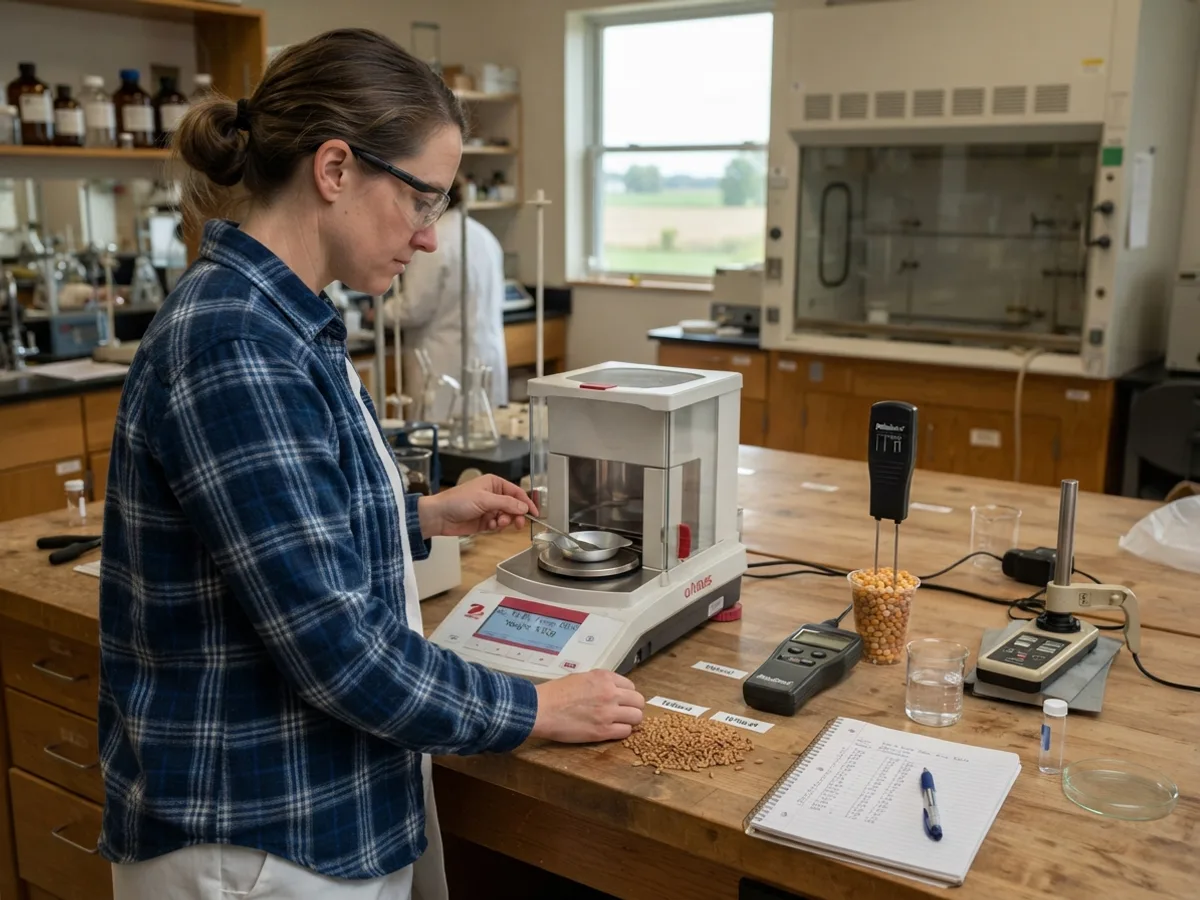
Oven-drying is the laboratory gold standard. You weigh a sample, heat it in a controlled oven at a specific temperature (usually 100 to 130°C) until mass no longer changes, then weigh it again. The difference in mass is water lost; the percentage of water relative to the original wet weight is moisture content.
This method is accurate within 0.1% and works on nearly any material. However, it is destructive (the sample is consumed) and slow—AOAC method 925.09 for flour takes more than 5 hours. It also requires access to a calibrated oven and analytical balance, making it unsuitable for field work or production-line speed.
Capacitance and Pin-Type Meters
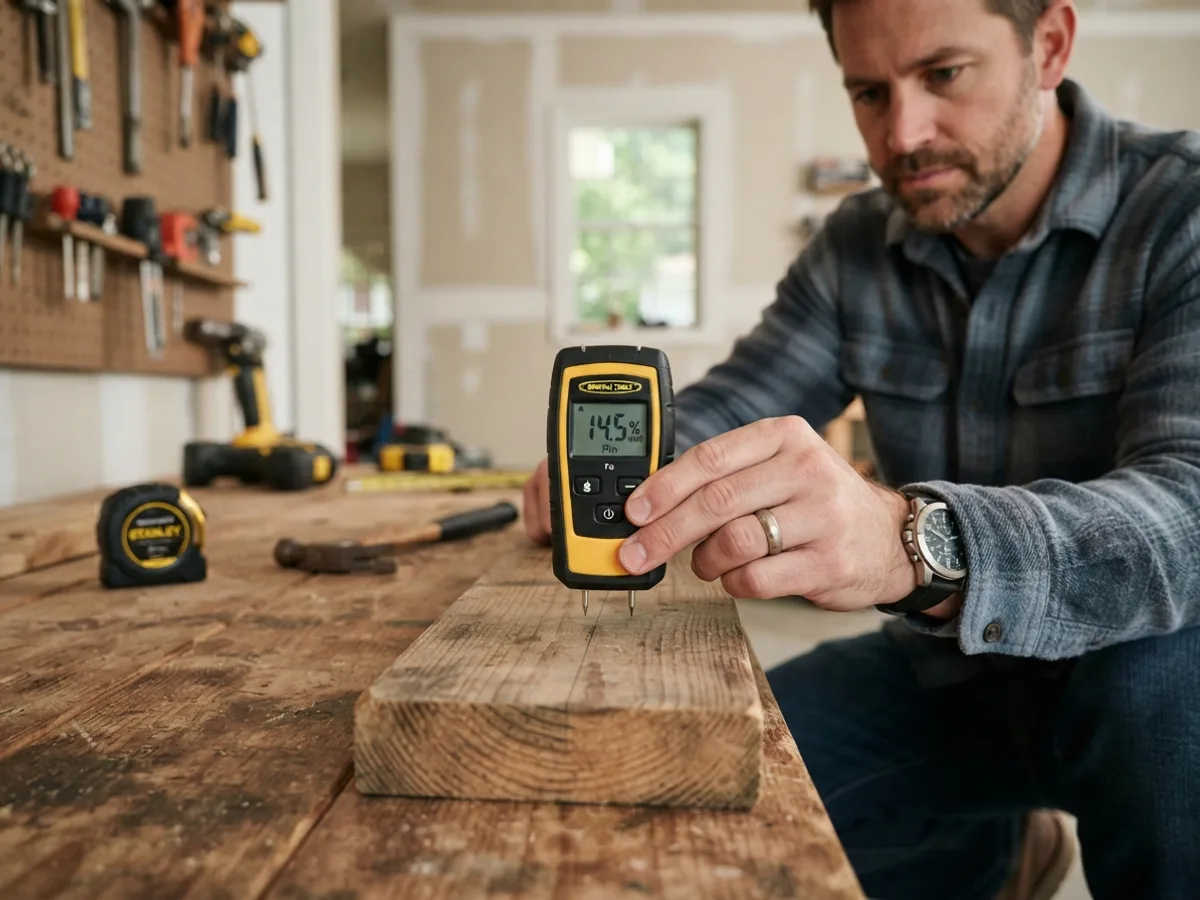
Handheld pin-type meters use two prongs that penetrate the sample and measure the electrical capacitance between them. Water is an excellent electrical conductor; dry material is not. The meter converts capacitance into a moisture reading displayed on a digital screen.
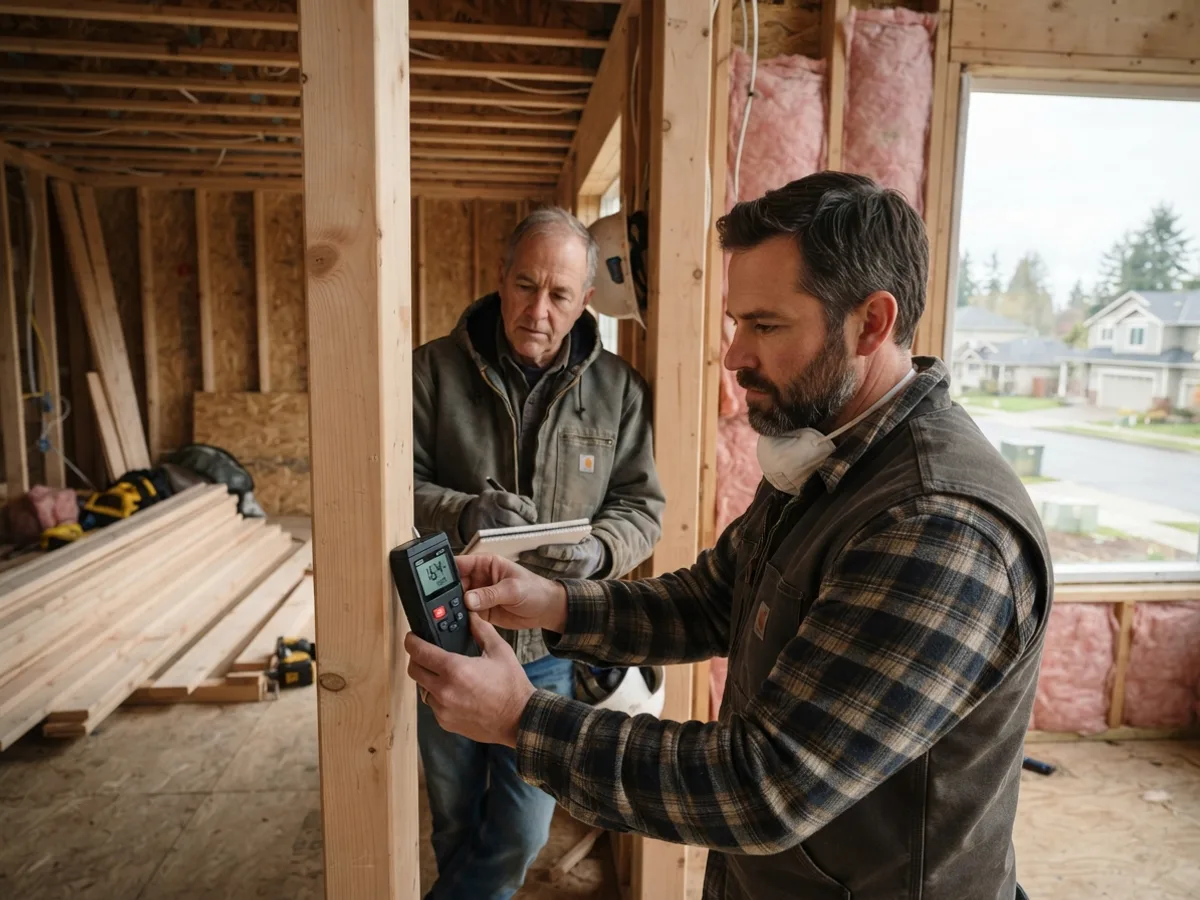
Pin-type meters are fast (results in seconds), portable, and non-destructive. Accuracy ranges from ±1% to ±3% depending on material type and calibration. However, they are material-dependent—a meter calibrated for softwood will give false readings on hardwood—and they only measure the volume directly between the pins, not the full depth of the sample. Surface moisture can also skew results. Most pin meters require you to select the wood species or material type from a menu before taking a reading.
Resistance-Type Meters
Resistance meters measure the electrical resistance of the material between two electrodes. As moisture content rises, resistance drops. The meter converts this resistance into a moisture percentage.
Resistance meters excel in wood and grain because water content directly affects wood fiber resistance. They are faster than oven-drying, portable, and less material-dependent than capacitance meters. Accuracy is typically ±2% to ±4%. Like pin meters, they are non-destructive and give instant feedback, making them popular in sawmills and grain elevators for in-process sorting.
Near-Infrared (NIR) Sensors
Near-infrared spectroscopy passes light in the near-infrared wavelength through or onto a sample. Water and organic materials absorb specific wavelengths. By analyzing the absorption pattern, NIR instruments predict moisture content and other properties (protein, fat, fiber) simultaneously.
NIR offers non-destructive analysis, production-line speed, and simultaneous multi-parameter output. Accuracy can reach ±0.5% when the instrument is properly calibrated to your specific product and sample matrix. NIR is expensive (tens of thousands of dollars) and requires periodic recalibration against reference samples, but it is the standard in premium grain trading, coffee roasting, and food manufacturing.
Karl Fischer Titration
Karl Fischer titration is a chemical method that quantifies water in a sample by dissolving the sample in a reagent that reacts only with water. The amount of reagent consumed directly indicates water content.
This method delivers lab-grade precision (±0.01% in many cases) and works on any material, including oils, solvents, and powders that are difficult to test with electrical meters. However, it requires laboratory equipment, trained technicians, and reagent cost. Karl Fischer is the standard for moisture in pharmaceuticals, oils, and chemicals where precision is non-negotiable.
How to Use a Moisture Meter Step-by-Step
Using a handheld moisture meter correctly ensures reliable readings. Follow these steps to minimize error.
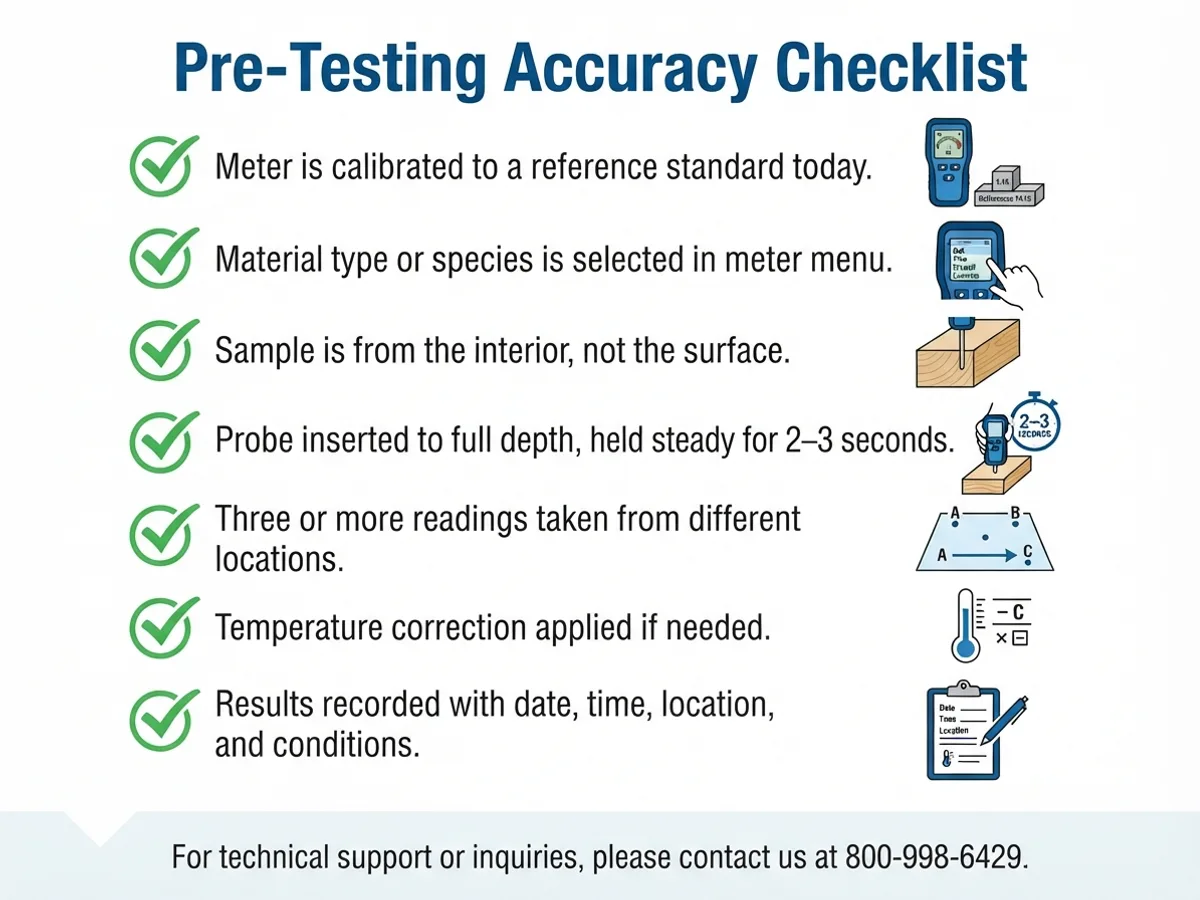
- Calibrate the meter against a reference standard or zero-point calibration material before each use. Most meters have a zero button or calibration mode—consult your manual.
- Select the correct material setting. If your meter has a species or material menu (wood, grain, concrete, drywall), choose the one that matches your sample. Using the wrong setting introduces systematic error.
- Prepare the sample. Use a representative piece from the interior of the material, not the surface. For grain, take samples from multiple depths in a bag or bin.
- Insert the pins or sensor into the sample perpendicular to the surface, pressing firmly. For pin meters, insert both prongs to the same depth; for resistance probes, ensure full contact.
- Hold steady for 2 to 3 seconds until the reading stabilizes on the display. Do not wiggle or move the meter—motion causes flickering and false readings.
- Record the result. Take a minimum of three readings from different locations in the sample and record the average. A single reading from one spot is not representative.
- Note environmental conditions. Temperature and relative humidity affect meter readings. Most meters have a temperature correction—if your workspace is cold or hot, apply the correction factor from the manual.
- Store the meter in a dry case between uses. Moisture in the meter electronics degrades accuracy over time.
Moisture Content Formula and Calculation
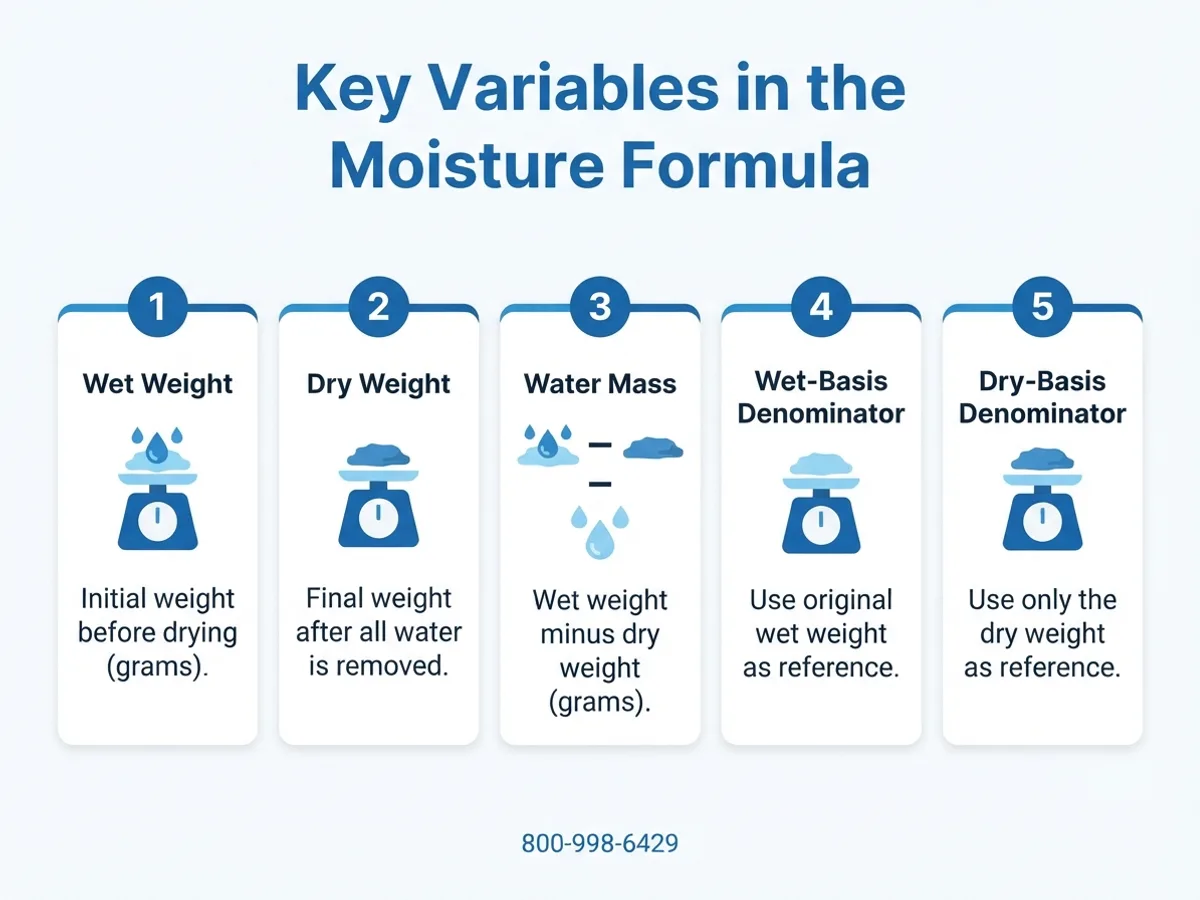
Moisture content is calculated using a simple algebraic formula that compares the weight of water lost to a reference weight. Two formulas are standard depending on your reporting method.
Wet-Basis Moisture Content Formula:
MC(%) = [(wet weight − dry weight) / wet weight] × 100
This is the most common formula in industry. You subtract the final dry weight from the initial wet weight to get the mass of water. Divide that by the original wet weight and multiply by 100 to express it as a percentage.
Dry-Basis Moisture Content Formula:
MC(%) = [(wet weight − dry weight) / dry weight] × 100
Instead of dividing by the wet weight, you divide by the dry weight. This is preferred in chemistry and timber because it isolates the water relative to only the solid matter in the sample.
Worked Example:
You have a wood sample that weighs 100 grams when freshly cut (wet). After oven-drying for 3 hours at 105°C, it weighs 82 grams (dry). Using the wet-basis formula:
MC(%) = [(100 − 82) / 100] × 100 = [18 / 100] × 100 = 18%
The wood is 18% moisture on a wet basis. Using the dry-basis formula for the same sample:
MC(%) = [(100 − 82) / 82] × 100 = [18 / 82] × 100 = 21.95%
The same wood is 21.95% moisture on a dry basis. Both are correct; they describe the same sample using different denominators. Choose whichever formula your industry or standard requires.
Tips for Getting Accurate Readings
Precision requires discipline. These practical tips separate field operators who get consistent results from those whose readings vary wildly.
Take Multiple Readings at Different Depths. A single reading at one spot is not representative. Moisture in grain, lumber, and composites is never uniform—surface is often drier than the interior. Take at least three readings from different depths and locations, then average them. This reveals spatial variation and catches outliers caused by hidden pockets of liquid or foreign material.
Account for Temperature Correction. Electrical meters (pin-type and resistance) are sensitive to temperature. A meter calibrated at 70°F will read low if you use it at 40°F and high at 90°F. Most meters include a temperature correction table or automatic sensor. Measure the sample temperature and apply the correction before recording the result. Ignore this step and your readings will drift with the weather.
Choose the Right Meter Setting and Calibration Standard. A wood moisture meter calibrated for softwood (pine, fir) will read false on hardwood (oak, maple) because hardwood has different electrical properties. Similarly, a concrete moisture meter will not work accurately on leather or food. Always select the material type that matches your sample. If your meter does not have a setting for your material, use a lab method (oven-drying or Karl Fischer) instead.
Avoid Surface Moisture. Surface moisture that has not yet equilibrated into the bulk of the material will bias pin-meter readings high. Wipe or lightly sand the surface with dry cloth or fine sandpaper before probing. This is especially important after rain, condensation, or wet handling. Allow the sample to sit in the measuring environment for at least 30 minutes to stabilize before testing.
Calibrate or Zero the Meter Before Each Use. Drift in the meter's electronics is invisible but cumulative. Use a reference standard (often supplied with the meter) to verify zero point at the start of each day. If the meter fails to zero, have it serviced before continuing—a drifted meter will read consistently wrong across all samples, masking the error.
Record Environmental Conditions. Keep a log of ambient temperature and relative humidity when you test. Seasonal changes affect wood moisture content—a board at 12% in winter may climb to 15% in summer as humidity rises. Knowing when and where you measured helps explain variation over time and supports traceability for audits.
Common Mistakes and How to Avoid Them
These errors recur in every lab and production floor. Awareness and discipline eliminate them.
- Measuring only the surface. Pins inserted less than 1 inch deep miss interior moisture gradients. Lumber and grain dry from the outside in; a surface reading of 12% may hide a core at 18%. Always insert the probe to the full depth of the material or at least 1 to 2 inches.
- Ignoring equilibrium moisture content. Most materials absorb or shed moisture until they balance with the surrounding air. Wood at 8% in a dry warehouse will climb toward 12% if moved to a humid factory. Taking one reading and assuming it is stable across seasons leads to false inventory decisions. Test in the environment where the material will be stored or used.
- Using the wrong meter mode or material setting. A meter switched to 'hardwood' on a softwood sample will read 3–5% too high. A concrete meter will fail on ceramics. Always verify the setting before pressing the trigger. If you are unsure, consult the manual or run a spot check with a lab method.
- Skipping calibration. A meter that reads 14% when a certified standard is 12% will bias every sample you test by +2%. Calibration drift is silent—you will not know it is happening unless you check. Make zero-point calibration a ritual before work each day.
- Taking a single reading. One reading at one location tells you nothing about the sample's average moisture content. Pin meters see only the volume between the two prongs. A wet pocket 2 inches away from the probe will be missed. Take three or more readings and average them. Discard obvious outliers and investigate if two readings differ by more than 2%.
- Failing to account for temperature. A pin meter used on cold wood outdoors will read 2–4% lower than it should because electrical resistance increases in cold. Many meters have temperature correction built in, but you must enable it. Check your meter's manual and apply the correction before recording results.
Measuring moisture content accurately is achievable with the right method and disciplined technique. For critical decisions, oven-drying or Karl Fischer titration remains the lab standard. For production speed, pin-type and resistance meters deliver results in seconds when properly calibrated and applied. The wet-basis formula MC(%) = [(wet weight − dry weight) / wet weight] × 100 is your foundation; always take multiple readings at different sample depths, account for temperature, and zero your meter before each use. Scientificgear provides repair, calibration, and on-site training for Karl Fischer titrators, moisture analyzers, and related laboratory instruments. When precision matters, proper equipment maintenance and user discipline are inseparable. For help selecting or maintaining the right moisture measurement system for your operation, contact us for a demonstration.
Frequently Asked Questions
What is a normal moisture content for wood?
Typical in-service moisture content for interior wood is 6% to 12%, depending on the heating season and building humidity. Freshly felled wood may be 50% or higher. Kiln-dried lumber sold in stores is usually 8% to 12%. Outdoor wood exposed to weather runs 12% to 18% depending on climate and time of year. The goal is to match the moisture of the wood to where it will be used.
What tool measures moisture content most accurately?
Karl Fischer titration is the most accurate lab method, often within ±0.01%. Oven-drying (gravimetric method) is the reference standard at ±0.1%. Portable handheld meters (pin-type and resistance) are accurate to ±1% to ±3% depending on material and calibration. NIR spectroscopy can reach ±0.5% when properly calibrated. Choose the tool that matches your speed requirement and material type.
How do I calibrate a moisture meter?
Most meters have a zero-point calibration mode—press the zero or calibration button and place the meter on a reference standard supplied by the manufacturer, usually a ceramic disc. Allow the meter to stabilize for a few seconds, then store it away. Perform this zero check before each use or each day of testing. If the meter fails to zero or drifts, it needs professional calibration and repair.
What is the difference between wet-basis and dry-basis moisture content?
Wet-basis divides the water mass by the original wet weight; dry-basis divides by the dry weight only. Wet-basis ranges from 0% to 100%; dry-basis can exceed 100%. Wet-basis is more common in food and agriculture. Dry-basis is standard in chemistry and timber because it relates water only to the solid matter. Both describe the same sample correctly—choose the formula your industry standard requires.
Why does my moisture meter give different readings in winter and summer?
Handheld meters are temperature-sensitive. Cold material reads lower; warm material reads higher because electrical resistance changes with temperature. Most meters include a temperature correction built into the firmware or as a lookup table in the manual. Measure the sample temperature and apply the correction before recording results. Also, seasonal humidity swings cause wood and grain to naturally absorb or shed moisture until they balance with the air—test in the same environment where the material will be used.
Can I use a wood moisture meter on grain or concrete?
Not reliably. A wood moisture meter is calibrated for the electrical properties of wood fiber and will read false on grain or concrete because they have different electrical characteristics. Use a meter designed for your material, or use a lab method such as oven-drying that works on any material. Many manufacturers sell universal or multi-material meters, but they are less accurate than material-specific meters.
How long does oven-drying take?
Oven-drying time depends on material thickness and density. Thin samples (paper, thin film) may dry in 1 to 2 hours. Grain samples typically take 4 to 6 hours. Thick wood or dense materials can take 10 to 24 hours or more. AOAC method 925.09 for flour specifies more than 5 hours at 130°C. Always check your industry standard method for the correct temperature and time before starting.
Amazing scientific equipment! I loved my Automatic Titrator! Would buy again.
Amazing scientific equipment! I loved my Automatic Titrator! Would buy again.